What is Emergency Lighting?
Emergency lighting is a special type of lighting that activates during power outages or other situations where the normal lighting fails. It helps people safely find their way to the emergency exits.
Types of Emergency Lighting:
- Transparent Emergency Lighting at Emergency Exits
Ensures that emergency exits remain clearly visible, even in complete darkness. - Escape Route Lighting
Specific emergency lighting with pictograms indicating the emergency route, such as hallways, stairs, and doors. This helps individuals avoid obstacles and safely navigate toward the emergency exit. - Anti-Panic Lighting
Assists people in large spaces to remain calm and locate the escape route.

Explanation of Escape Route Indicators and Escape Route Signs
In emergencies such as fires, explosions, or other critical situations, it is crucial that people can quickly and safely leave a building. Escape route indicators and escape route signs play an essential role in this. Below is an explanation of what these tools entail, why they are important, and how they are applied.
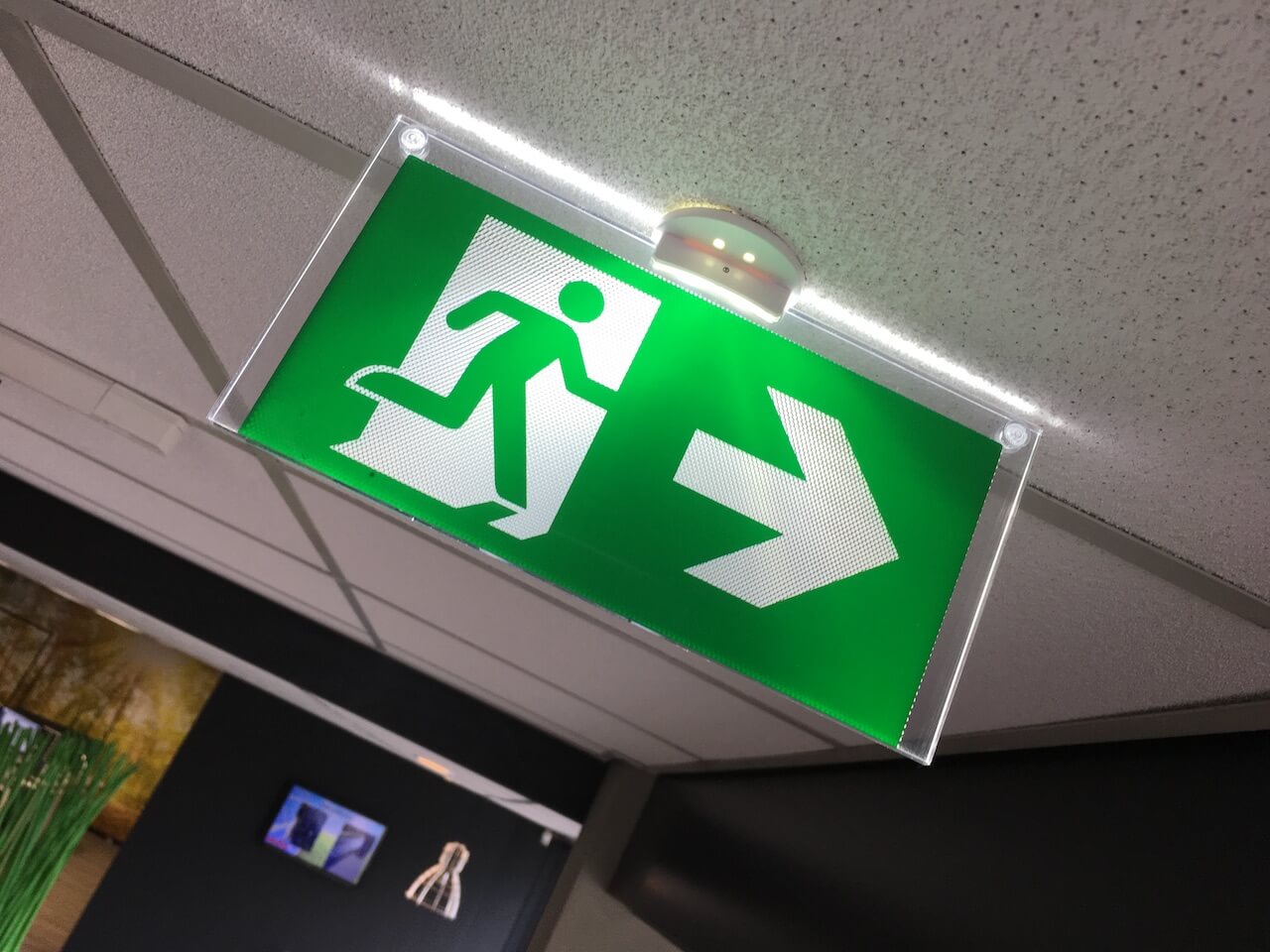
What is Escape Route Indication?
Escape route indication refers to the set of tools and markings that show the route to be followed to reach a safe exit in case of an emergency. This includes not only signs but also floor markings, illuminated panels, and other signals that enhance the visibility and recognition of the escape route.
NEN Standards for Emergency and Escape Route Lighting
- NEN-EN 50171
Defines the general requirements for centrally powered emergency lighting systems. The setup and installation of systems are extensively described. - NEN-EN 1838:2013
The European standard applicable to emergency lighting in buildings accessible to the public and employees. - NEN-EN-IEC 60598-2-22
Describes the requirements for lighting fixtures. - NEN-EN-ISO 7010
Outlines the safety symbols and colors, including the globally recognized and accepted escape route indication pictogram. - NEN-EN 50172
Contains regulations on emergency lighting, the design of an emergency lighting system, system selection, maintenance, and record-keeping. This standard frequently refers to NEN-EN 1838. - NEN 1010
The standard for safety provisions for low-voltage installations, including specific technical requirements for areas used for medical purposes.
What Are Escape Route Signs?
Escape route signs are visual aids placed along escape routes to indicate the locations of emergency exits and how to reach them. They are designed according to international standards (such as ISO 7010) to ensure clarity and uniformity. These signs use pictograms, typically with a white symbol on a green background, to indicate that they represent a safe escape route.

If you are interested or would like more information, please feel free to request a no-obligation quote.
Emergency lighting
| Maintenance scale prices emergency lighting | Scale amount | Price per item |
| Maintenance per emergency light | 1 | €30,25 |
| Maintenance scale prices emergency lighting | 2-4 | €21,53 |
| Maintenance scale prices emergency lighting | 5-8 | €19,43 |
| Maintenance scale prices emergency lighting | 9-15 | €18,15 |
| Maintenance scale prices emergency lighting | 16 - 20 | €14,85 |
| Maintenance scale prices emergency lighting | 21-50 | €11,00 |
| Maintenance scale prices emergency lighting | 51-1500 | €8,05 |
| Maintenance scale prices emergency lighting | +1500 | Price on request |
| Maintenance for every unit higher than 3 meters from the gound | Price on request |
technician/inspector costs
| Assembly and technician/inspector hours (also for additional work in consultation with the technician/inspector) | € 77,00 | Per hour / per (REOB) technician/inspector. |
| General Report | €45,00 | for 1 object |
| General Report | €90,00 | for 2+ objects |
| Call-out Costs | € 26,60 | Per visit / per REOB technician's vehicle. |
| Parking costs will be charged on the invoice | 1 to 1 | Per REOB technician's vehicle as agreed / per visit. |
| Waiting time for the technician/inspector regarding the accessibility of units. | €77,00 | per REOB technician / per hour |
| For distances greater than 25 km from our Headquarters in The Hague. | € 0,25 | Per km / per visit / per REOB technician's vehicle. |
| *= Price per kilometer if the distance to the location is greater than 25 km from our headquarters at Vuurrood Veiligheid, Junostraat 6, 2516BR The Hague. This will be calculated based on post-calculation and determined in consultation with the technician during execution, according to a signed service receipt. | ||
Additional maintenance actions for emergency lighting
| (Re-)Installation of Emergency Lighting | 30-60 minutes of technician time | per unit |
| Disposal Costs for Complete Emergency Lighting (including lamp, fixture, and battery) | €4.50 | per unit |
| Disposal Costs for Fixture (without lamp or battery) | €0.50 | per unit |
| Disposal Costs for Lamp (without fixture or battery) | €0.50 | per unit |
| Disposal Costs for Battery (without fixture or lamp) | €3.50 | per unit |
Electric Emergency Lighting
Emergency lighting is installed on the ceiling or a wall. In the event of a power outage in the building, the emergency lighting must activate within 15 seconds. The built-in battery ensures that the emergency lighting remains operational for at least one hour. This lighting is essential to ensure that individuals inside the building can safely exit during a power failure.
Emergency Evacuation Lighting
Escape Route Lighting
Emergency lighting equipped with escape route markings (such as shown in the image above) is also referred to as escape route signage. Unlike regular emergency lighting, escape route signage is permanently illuminated. In the event of a power outage for any reason, the integrated battery must reactivate the lighting within 15 seconds.
Escape Route Signage Based on Tritium
In addition to electrical emergency route lighting, there is also emergency route lighting based on tritium.
This form of emergency route lighting requires no maintenance for at least 15 years and is ideal for locations without a power connection, but it is significantly more expensive than more conventional electrical emergency route lighting. Tritium light works on the basis of glass tubes filled with a fluorescent powder and tritium gas.
The disadvantage of tritium light is that it must be activated by an external light source. In an office situation, this is not an issue, but in other situations, the use of this light can be somewhat more problematic.
Anti-Panic Lighting
Anti-panic lighting enables people to reach the escape route. Anti-panic lighting has a horizontal illuminance of at least 0.5 lux on the floor. The 0.5 lux does not apply to a boundary zone of 0.5 m from the area.
Lighting for Workplaces with Increased Risk
Lighting for workplaces with increased risk ensures the safety of persons who, as part of their job, are responsible for (hazardous) processes or may find themselves in a dangerous situation. The lighting enables them to perform a proper shutdown procedure, so the safety of other people in the building is not jeopardized.
For emergency lighting for workplaces with increased risk, the following applies:
At least 10 percent of the normal illuminance level.
A minimum illuminance of 15 lux on the floor.
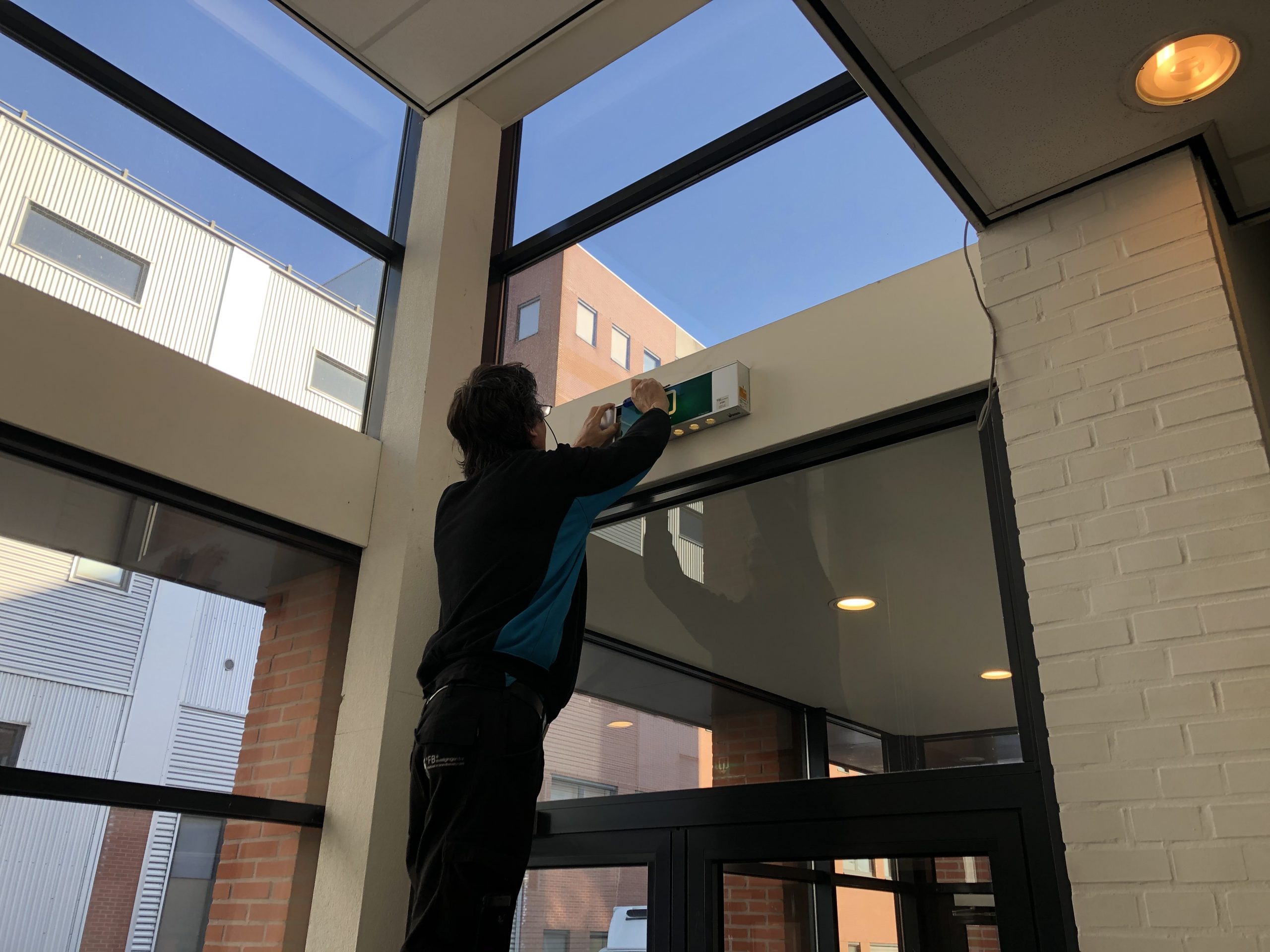
Escape route signage must always be placed at:
- Every exit door for evacuation.
- All staircases, with each step receiving direct light.
- Every level change.
- Every escape route sign and emergency exit.
- Every directional change of the escape route.
- Every hallway intersection.
- The evacuation exit.
- The first aid post (5 lux).
- Every fire extinguishing provision or fire alarm point (5 lux).
The required 5 lux only applies if these provisions are not located within an escape route or anti-panic area.
Would you like to have your safety equipment inspected? Request a completely non-binding quote:
Onderhoud noodverlichting
Maintenance of Emergency Lighting
The inspection of the proper functioning of the emergency lighting system must be carried out at least once a year. For the inspection, the following documents must be available:
- Current scale drawings of the building with the emergency lighting layout.
- Evacuation plans – to determine the escape routes.
- Reports of previous inspections.
- Logbook of performed maintenance.
- Reports of risk assessments and evaluations regarding high-risk workplaces and/or emergency lighting.
- Any additional documents, if applicable.
The more units that get checked in a single visit, the lower the price will be per unit.