Fire extinguishers must be placed in the workplace in such a way that they can be deployed as quickly as possible in the event of a fire. Fire extinguishers should be clearly visible and easily accessible. In practice, this often means that the location of the fire extinguisher is indicated with a pictogram, and the walking distance to a fire extinguisher does not exceed 30 meters. In practice, small portable extinguishers are commonly referred to as fire extinguishers.


The NEN 4001 standard specifies how many fire extinguishers should be placed in a given area. This determination is based on several factors, including:
- What is the risk of fire?
- How many people are present?
- What is the size of the building, object, and workplace?
The higher the risk, the number of people present, and the size of the building or object, the more fire extinguishers need to be installed. For high-risk areas, you can expect approximately one fire extinguisher per 100 m². In low-risk areas, about one extinguisher per 300 m² may suffice. A portable fire extinguisher in the workplace should be equipped with an average of 6 liters or 6 kilograms of extinguishing agent, and the fire hose reel must be directly connected to the water supply.
You can choose from the following types of portable fire extinguishers (click for more information):
- Powder extinguishers
- Spray foam extinguishers
- Carbon dioxide (CO2) extinguishers
In addition, many buildings or objects have wall-mounted fire hose reels installed during construction. These options are all safe for humans and animals. The type of extinguisher you choose depends on the fire risk and the presence of electronics. The choice of extinguisher is influenced by the specific fire risk, as well as any potential hazards associated with the use of that particular extinguisher. For instance, powder extinguishers can obstruct visibility, while CO2 extinguishers can cause frostbite upon skin contact.
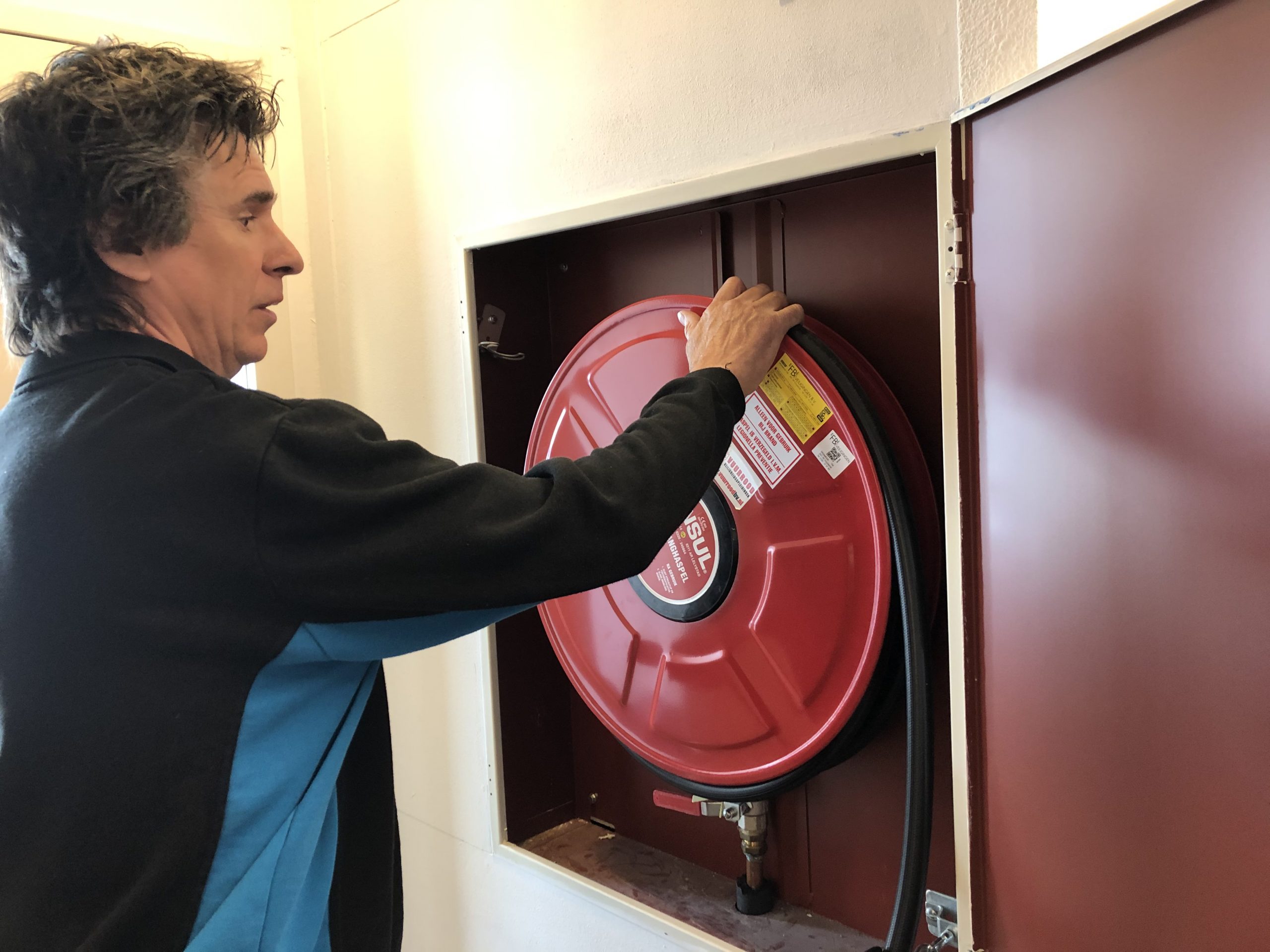
Fire hose reels are mandatory in many buildings. These reels are only suitable for Class A fires, which involve solid materials. Water is very effective at cooling such materials, reducing the risk of re-ignition. The fire hose reel is the most commonly used firefighting tool worldwide. The fire department uses larger, separate hoses for water-based firefighting.

The hose is wound on a reel and is permanently connected to the water supply network. The length of the hose depends on the fire compartmentation, but it is commonly available in lengths of 20, 25, or 30 meters. The nozzle has a valve with three settings: closed, spray jet, and solid jet.
The spray jet is particularly useful for cooling a larger area around the fire. Additionally, the spray setting acts as a heat shield, making it easier to keep flames at a distance or extinguish them. The steam generated also has a suffocating effect on the fire.
In offices or similar environments, spray foam extinguishers are generally used. These extinguishers have high extinguishing power for solid materials, classified under fire class A, and are safe to use with electronics if labeled “caution with electrical installations.” This includes items like computers, copiers, and devices that operate on standard electricity rather than high-voltage power. After use, the foam can easily be cleaned up with water. This extinguishing agent is safe for use around both people and animals.
Sproeischuimblusser

Poederblusser
The powder extinguisher is typically used in situations where the fire risk is very high or in areas where the powder does not have a negative impact or cause collateral damage. An example of this would be outdoor locations like gas stations.

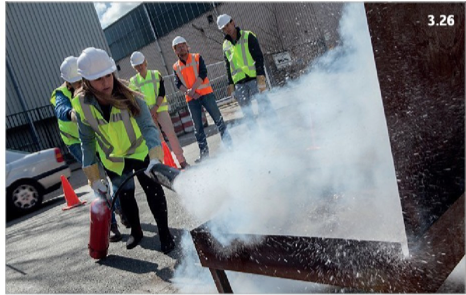
Powder extinguishers have a very high extinguishing capacity and can be universally used for extinguishing fires in classes A, B, and C. Additionally, they can be used to extinguish equipment that is under electrical tension.
With a different powder extinguishing agent, these extinguishers can also be used for burning metals, classified as fire class D.

These powders consist of a mixture of salts and are relatively harmless to humans and animals during extinguishing. Because the powder is made of salt, it is thin and light, allowing it to suffocate flames by creating a powder cloud released upon activation.
The carbon dioxide extinguisher, also known as a CO2 extinguisher, is suitable for extinguishing liquid fires (fire class B) and fires involving equipment under electrical tension. The main advantage of a CO2 extinguisher is that the extinguishing agent (CO2) leaves no residues or collateral damage when used. This extinguisher must be used in one extinguishing attempt to prevent oxygen supply, thereby suffocating the fire. CO2 leaves the extinguisher cylinder at -79 degrees Celsius through a high-pressure hose and emerges as an extinguishing gas from the snow horn. The snow horn, also known as the expansion horn, is characteristic of the CO2 extinguisher. While this gas does not cool the fire, it is extremely cold to the touch, so caution is necessary when using it near people and animals, and when extinguishing in small spaces where there is a risk of oxygen depletion, such as in a restroom.
The wet chemical extinguisher is designed for fire class A and fire class F. This extinguisher looks similar to a foam extinguisher but contains a special extinguishing agent, chemical foam, specifically intended to cover and effectively extinguish burning cooking oil or fat. The chemical foam has emulsifying properties, which form a sealing layer by mixing with the burning liquid, effectively smothering the fire.

Moreover, it has a strong cooling effect, which quickly reduces the temperature of the liquid, bringing it below the auto-ignition point.
In addition to fire extinguishers for basic fire protection, supplementary fire extinguishers can be installed for specific risks, such as machinery, computer rooms, electrical cabinets, and hazardous materials. For supplementary fire protection, all types of extinguishers are permitted, including smaller fire extinguishers.
Given the danger of open flames in the workplace, there is a significant risk that people might catch fire. For this reason, an easily accessible extinguishing device is essential, and this is also required according to usage guidelines. This includes fire blankets. The fire blanket is intended to cover and smother a small fire. The fabric is made of non-flammable or highly flame-resistant material, sometimes coated with a fire-retardant agent. The fire blanket’s holder always displays instructions for use, without indicating a fire class, and includes the size. The size is important to ensure that the blanket is large enough to fully cover the fire.

Fire extinguishers are subject to European standards. In the Netherlands, only fire extinguishers with a Dutch type approval may be sold. Such a device complies with the Portable Fire Extinguishers Regulation of 1997 and NEN-EN 3. The type approval is issued by the National Center for Prevention (NCP) on behalf of the Ministry of the Interior.
If the seal on a fire extinguisher is broken, the device must be re-inspected. If the fire extinguisher is removed for this purpose, a replacement fire extinguisher is usually provided. A seal is also attached to the supply valve of a fire hose reel.


The inspection of fire extinguishers is not always mandatory. Privately, one is generally not required to have the fire extinguisher and/or fire hose reel periodically checked.
An exception might be if such a requirement is imposed by an insurance policy. In a business setting, regulations mandate that fire extinguishers must be checked by a qualified person at least once every twelve months. The extinguishers are then provided with a maintenance sticker, seal, and guarantee that must be performed by an accredited REOB maintenance company.
X = not * = reasonable ** = good
The goal of fire fighting is not only to extinguish a fire but also to secure and evacuate victims, prevent damage, and avoid inconvenience.
The dangers of fire are present wherever oxygen is available. Additionally, there are many different types of fire and extinguishing agents. Fuels are substances that ignite at high temperatures. Fuels can be in the form of solids, liquids, or gases.
Extinguishing agents are the means used to put out burning fuels. These agents also come in solid, liquid, and gas forms.
Depending on the pressure, temperature, and composition, substances can exist in three states of matter: solid, liquid, or gas. Changes in conditions can alter the state of matter.
Solid Substances
Many objects are composed at least partly of solid substances, which is why we can handle them. Everything we walk on, lean against, or sit on is made wholly or partly of solid substances. Examples of solids include metal, plastic, textiles, ceramics, and glass. In nature, solids appear as stones, as well as plant material like wood.

Liquids
In this phase, the substance is liquid, commonly abbreviated as L (liquid) in chemistry. Depending on the temperature, the substance’s property can change from viscous to thin and fluid.

Gaseous State
In everyday life, the term “gas” has a slightly different meaning. Even air is a gas but is not commonly referred to as such. Different categories of gas in daily life include:
- Energy Source Gas: Gases used as an energy source, either from pressurized gas cylinders or gas lines.
Examples: Natural gas, butane, propane, LPG. - Toxic Gas: Gases that are harmful or fatal if inhaled.
Example: Carbon monoxide. - Lightweight Gas: Gases that are lighter than air and used to fill balloons.
Examples: Helium and hydrogen.
Gases spread or mix more easily than solids or liquids in open spaces or in the atmosphere.

Before attempting to extinguish a fire, it is crucial to understand what is burning. Not all types of fires can be extinguished with the same extinguishing agent or method. Additionally, using the wrong extinguishing agent can create life-threatening situations. For example, using water from a fire hose to extinguish electrical installations poses the risk of electric shock, as water conducts electricity.
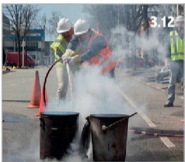
We refer to fire when visible (light) and detectable (heat) flames are fully under control in a place where we want them, such as during cooking or using a fireplace. When flames spread uncontrollably to places where we don’t want them and are beyond our control, it is considered a fire. Fires typically cause damage.
When a solid material is sufficiently heated, it releases combustible gases through a process called pyrolysis (smoldering). Once enough gases have been released and mixed with air (oxygen), ignition can occur (flaming stage). After all the gases from the solid material have burned off, the remaining part of the solid material will continue to glow until it is converted into ash (glowing stage). When the glowing stage no longer emits light, it is also referred to as smoldering.


Fire has:
- Fuel;
- Oxygen;
- and ignition temperature.
This is called the fire triangle. If one or more of these three factors is missing, fire cannot exist.
So, there are three approaches to fire fighting:
- Removing the fuel;
- Smothering;
- Cooling.
Removing the fuel is sometimes the simplest method, such as turning off a gas valve. However, it is often impossible and dangerous in other ways. For example, moving or touching fire makes it impossible to ensure your own safety and is therefore not part of a safe extinguishing procedure.
If the oxygen can be “removed” or the fuel can be cut off from the oxygen, for example by covering it, you create smothering or extinguish the fire. In smothering, the available oxygen is burned while preventing new oxygen from reaching the fire.


Oxygen is in the air around us, approximately 21% of the atmosphere. Removing oxygen can also be done through displacement by a gas or steam. The more oxygen, the fiercer the fire; the less oxygen, the weaker the fire.
Cooling by ventilating a room, either naturally or with a fan, introduces all the dangers of spreading due to oxygen supply, so this method is only used by professional firefighters. However, cooling the fire with, for example, water provides extinguishing action and reduces the chance of re-ignition. The hot steam formed also displaces the oxygen. First aiders use this method only for small fires due to the risk of steam.
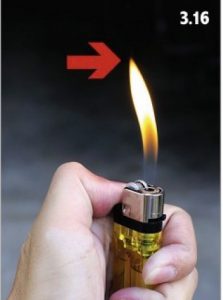
A fuel can only react with oxygen if there is enough heat. This is called the ignition temperature. There must be sufficient heat for the fuel to ignite. Heat can come from a match, a spark (electricity), a burning cigarette, a lighter, friction, etc.
An incipient fire is a fire at the location where the fire has started. At this stage, the first aider can perform an extinguishing procedure if they have the right extinguishing agent for the appropriate fire class.
A fire class refers to a group of similar fires, categorized by the nature of the fuels. This is primarily important for fighting a fire with an extinguishing agent. The different fire classes are: Class A, B, C, D, and F.
Class A Solid Material
This class indicates that the extinguishing agent is suitable for extinguishing solid materials such as wood, paper, textiles, etc.
Class B Liquid
This class indicates that the extinguishing agent is suitable for extinguishing liquids and liquefiable substances, such as oil, gasoline, alcohol, fats, etc.
Class C Gas
This class indicates that the extinguishing agent is suitable for extinguishing gases, such as butane, propane, and natural gas. (Note that when extinguishing gases, you must be able to shut off the gas supply afterward; otherwise, a gas cloud may form, which could explode later when exposed to an ignition source.)
Class D Metals
This class indicates that the extinguishing agent is suitable for extinguishing flammable metals, such as magnesium, aluminum, sodium, potassium, zirconium, lithium, etc.
Class F Oils and Fats
This class indicates that the extinguishing agent is suitable for extinguishing very hot oils and fats, with quantities exceeding 5 liters. Examples include frying oil.

Fire class symbols:

The fire class is indicated on the fire extinguisher by a label and the corresponding letter.
(Staffelprijzen geldt voor het totaal van alle blussers + brandslanghaspels bij elkaar opgeteld per bezoek / uitvoerdatum)
| Onderhoud staffelprijzen blussers + brandslanghaspels | Staffel aantal | Prijs per stuk |
|---|---|---|
| Onderhoud per blusser of brandslanghaspel | 1 | € 30,25 |
| Onderhoud per blusser of brandslanghaspel | 2-4 | € 21,55 |
| Onderhoud per blusser of brandslanghaspel | 5-8 | € 19,45 |
| Onderhoud per blusser of brandslanghaspel | 9-15 | € 18,15 |
| Onderhoud per blusser of brandslanghaspel | 16-20 | € 14,85 |
| Onderhoud per blusser of brandslanghaspel | 21-50 | € 11,00 |
| Onderhoud per blusser of brandslanghaspel | 51-1500 | € 8,05 |
| Onderhoud per blusser of brandslanghaspel | 1500+ | Prijs op aanvraag |
| Onderhoud per blusser of brandslanghaspel gemonteerd op hoogte hoger dan 3m | Prijs op aanvraag | |
| Verzegeling per blusser | - | € 1,75 |
| Verzegeling per brandslanghaspel | - | € 1,75 |
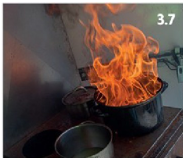
Fire Class F has been a new fire class for several years. Research has shown that fires in professional kitchens, canteens, and catering establishments often start due to excessive temperatures of frying fat or cooking oil. Once the temperature rises above 320 degrees Celsius, spontaneous combustion occurs, causing the fat or oil to ignite spontaneously.
The cause of such fires is often traced back to malfunctioning temperature controls or the use of old, contaminated fat. These so-called ‘fat fires’ are difficult to extinguish with standard foam, CO2, or powder extinguishers, especially in cases of larger quantities of burning fat or cooking oil (more than 5 liters). Covering the fire with a fire blanket is also often insufficient in such cases. Due to the temperature of the fat or oil, re-ignition is common after extinguishing. Therefore, additional requirements for fire extinguishers used in kitchens with (frying) fat or cooking oil (both animal and vegetable) have been established. These additional requirements, known as Fire Class F, are specified in the British Standard norm: BS 7937.
If you are interested or would like more information, please feel free to request a no-obligation quote.
Are you interested and would you like to view our courses?
Is safety a requirement in your workplace? Take a look at our services